
When Leadership Means Wear Sensible Shoes: A Blizzard Story
There's a particular kind of institutional communication that nurses know well. It arrives via text or email, carefully worded, covering all the bases. It acknowledges the situation. It expresses appreciation. And then it offers one concrete, actionable piece of guidance.
Wear appropriate footwear.
That was the directive that came down during our recent blizzard. And to be fair, it wasn't wrong. Sensible shoes ARE a good idea in a snowstorm. But it's also the kind of guidance that can only come from someone who is not, at that moment, in the same zip code as the storm.
I know this because I used to be that person.
I spent years in nursing leadership. And I can tell you that the further you move from the bedside, the more the institution asks you to manage from a distance, to communicate via policy, to make decisions with incomplete information, to represent directives that came from somewhere even further up the chain than you. You become a translator between a system that runs on metrics and a team that runs on each other. It is a genuinely impossible position, and I have enormous respect for the people trying to do it well.
It's also why I left.
I would rather sleep on a stretcher navigating a blizzard alongside my nurses than hold a leadership title that puts me between my team and decisions I didn't make and can't change. That's not a criticism of the people in those roles, it's an honest reckoning with what the structure asks of them and what it costs everyone when the distance gets too wide.
During this particular storm, our clinical manager, who is twenty+ weeks pregnant, was in contact via secure chat throughout. Our OR manager stepped up as the representative voice for all of periop. Several unit managers didn't go home at all. They slept on stretchers right alongside their staff, pagers on, curtains pulled, not in a separate call room but actually present in the unit. That kind of leadership doesn't come from a directive. It comes from people who understand that sometimes showing up just means staying.
And the bedside staff? We did what we always do when the formal structures get thin.
All elective cases cancelled. One patient. ONE, who bypassed pre-op and PACU entirely and went straight to the ICU, meaning the team that braved the storm wasn't even needed for the one case that existed. The rest of us spent 36+ hours keeping ourselves regulated, connected, and frankly, human.
We did the Cha Cha Slide in the hallway. We logged a full mile circling the unit in laps. We did a 5 minute TikTok viral bridal arm workout using bags of Lactated Ringer's as weights, because one of our nurses is getting married in six months and those arms are not going to tone themselves, blizzard or not. We ate everything that wasn't nailed down. An anesthesia resident showed us a few fencing moves. It felt reasonable.
With only one patient and a fully staffed unit, our nurses were asked to help out on the floors. Periop nurses can't take assignments on inpatient units. We can't access their documentation systems. But not one person said no. Nobody refuses a turn, a blood sugar check, a warm blanket, or simply the offer of an extra set of hands to a floor nurse stretched thin in a blizzard. We may not have been able to chart it, but we could show up for it, and so we did.
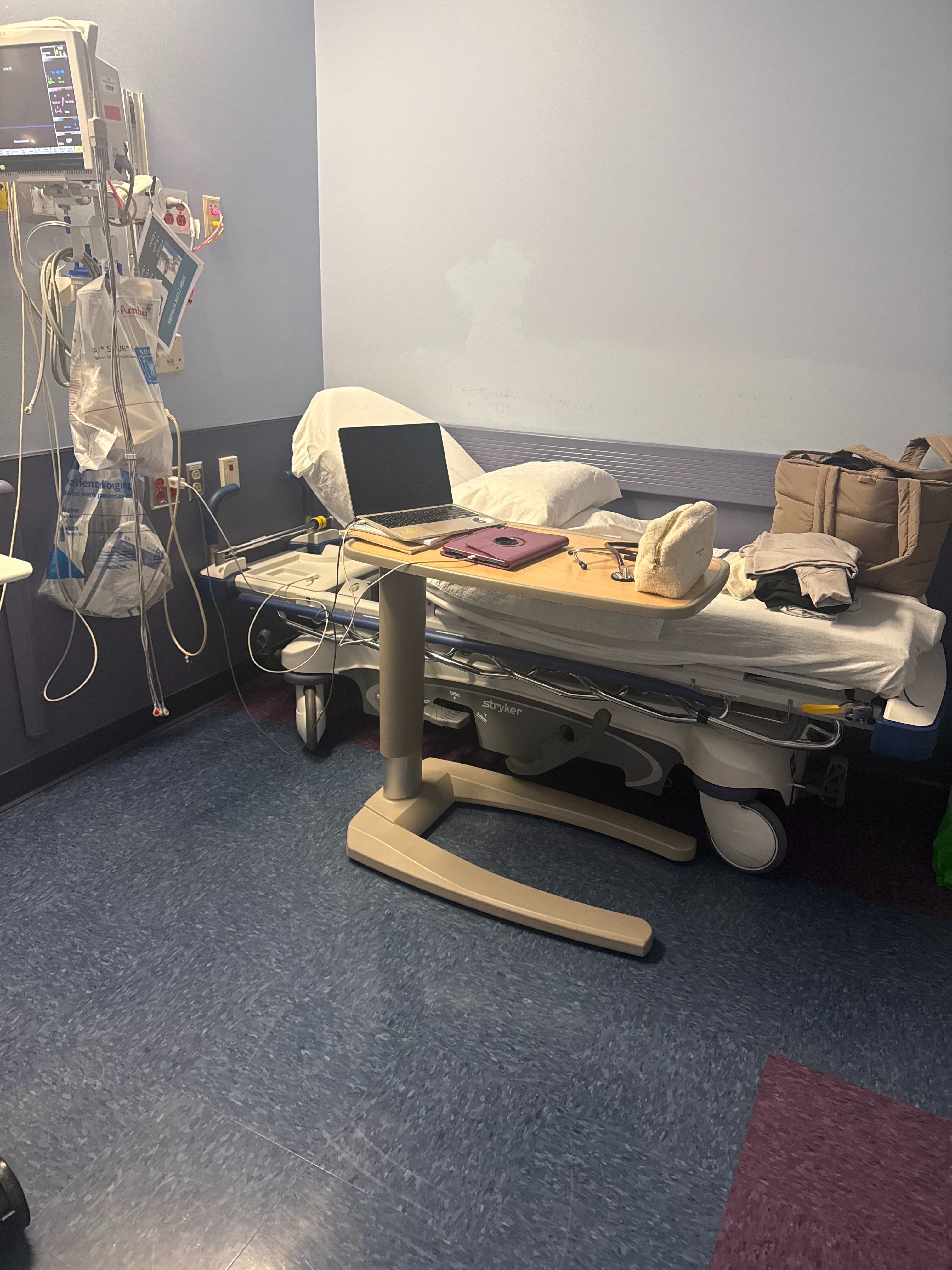
And when the day finally wound down, we slept. On stretchers. In the same unit where we work, separated by curtains that do absolutely nothing for sound. Some of us were on call, pagers clipped and ready. Others were off, colleagues who had simply stayed overnight to guarantee they'd make their morning shift when the roads were at their worst, no compensation promised, just commitment. And here is the thing about lying there in the dark with your pager on while your colleagues sleep on the other side of a thin curtain: you are not afraid of missing the page. You are afraid of the page waking them up before it wakes you. That particular anxiety, that hypervigilance oriented entirely toward protecting someone else's sleep, is so uniquely nurse it almost made me laugh. Even our rest is other-focused. Even our worry in the dark is about the person on the other side of the curtain.
Meanwhile, our rockstar Employee of the Month CNA had arrived at 5:30 AM and parked in her assigned offsite lot, because of course she did, and needed to bring her truck closer for a second overnight. A passing police cruiser offered us a ride through the snow. We rode in the back. It is not comfortable back there.
I had already fallen once while shoveling out my own car in my sensible shoes. Christina got out of the cruiser and went down flat on her back in the snow. As she lay on the ground, we were laughing so hard we could barely breathe as she said, "But I had my appropriate footwear on." You can't make it up.
A CNA and a nurse walked out into that dark, remote, snow-covered parking lot arm in arm. Not because it was a touching moment. Because it was the only way either of us was staying upright.
Between the two of us, we had followed the directive to the letter and hit the ground anyway.
The decisions that put nurses in hospitals during blizzards, whether staff are deemed essential, whether they are compensated for coming in the night before to guarantee they make their shift when conditions are at their worst, whether the risk is worth it, those decisions don't get made at the unit level. They get made by institutional leadership that may be in an entirely different weather system. By the time guidance reaches the bedside, it has traveled through so many layers that what remains is: wear appropriate footwear.
This is not about blame. The unit managers sleeping on stretchers with their staff were doing everything right. The pregnant manager texting from home was doing everything she could. The OR manager covering all of periop was doing more than asked. These are good people navigating an impossible structure.
But what kept that team regulated for 36+ hours wasn't a top-down wellness initiative. It wasn't a policy or a directive or a text reminder about footwear. It was each other. It was the Cha Cha Slide and the LR bag arm workout and the laughter in a snowy parking lot at hour 24. It was a CNA and a nurse holding each other upright, literally and figuratively, in a dark parking lot at the end of a very long day.
Co-regulation doesn't require a program. Sometimes it's just your people.
I left management because I knew I was more useful here, on the stretcher, in the hallway, doing the Cha Cha Slide at hour twelve. Not because leadership doesn't matter, but because the most important leadership in a blizzard happens at the bedside, between people who know each other, who see each other, who would rather fall down together in sensible shoes than navigate it alone.
That's what Barely Balanced Nurses is built on. Not perfect balance. Not top-down wellness. Just the radical, unglamorous power of showing up for each other.
Barely Balanced Nurses exists because this gap is real, it is costly, and nurses deserve better than surviving it alone.

